
Marshall Projected Release Date
A projected release date is a planning date. It is not the same as the actual release timestamp that appears after a person leaves custody. In Alabama ADOC custody, the research points to the `Minimum Release Date` field rather than a generic "projected release date" label. ADOC defines it as the earliest scheduled date an inmate can be released to probation or end of sentence, subject to changes from discipline, good time, new cases, sentence changes, and jail credit.
Marshall County Jail uses a different record path. A pretrial detainee has no reliable release date until bond, a court order, dismissal, transfer, or another legal event occurs. A sentenced county jail inmate may have a local sentence calculation, but the sheriff is the practical custodian for county jail release timing. A state prison date should not be used to compute a short county sentence unless the person is actually in ADOC custody.
Lookup Marshall Release Dates
Start with the custodian. The Marshall County released roster helps confirm a completed jail release, while the ADOC inmate search helps read release-planning fields for a person still in state prison. The Marshall County Circuit Clerk is important for jail credit, bond orders, sentencing orders, disposition, probation, and commitment to ADOC.
- Identify current custody: Marshall County Jail, ADOC, BOP, ICE, or post-release supervision.
- For a current ADOC inmate, search by AIS number when possible, or by first and last name if AIS is not known.
- Look for `Minimum Release Date`, then read `Parole Consideration Date` as a separate field.
- Check ADOC definitions for `Jail Credit`, `Good Time Received`, `Good Time Revoked`, `Time Served`, `Total Term`, and sentence type.
- For a Marshall County jail sentence, contact the Detention Center or request the jail booking and release record instead of relying on ADOC fields.
- For jail credit or a changed sentence, use the Circuit Clerk record because ADOC says jail-credit questions go to the applicable circuit clerk.
- For a pending state release notice, use Alabama VNS and the Marshall County VINELink check path where the case qualifies.
The Marshall County released inmate lookup is the better route after release has already happened, because a completed release may leave the current-custody systems.
Marshall County ADOC Release Date
Alabama's date label is a key local detail. The ADOC definitions page uses `Minimum Release Date`, and it explains why the date can move. That wording should guide a Marshall County projected release date search for someone in state prison. Natural search terms like projected date, tentative date, or release date still point to the same practical question, but the official field name matters when reading the state result.
The ADOC definitions page is the source for the release-date vocabulary used here.
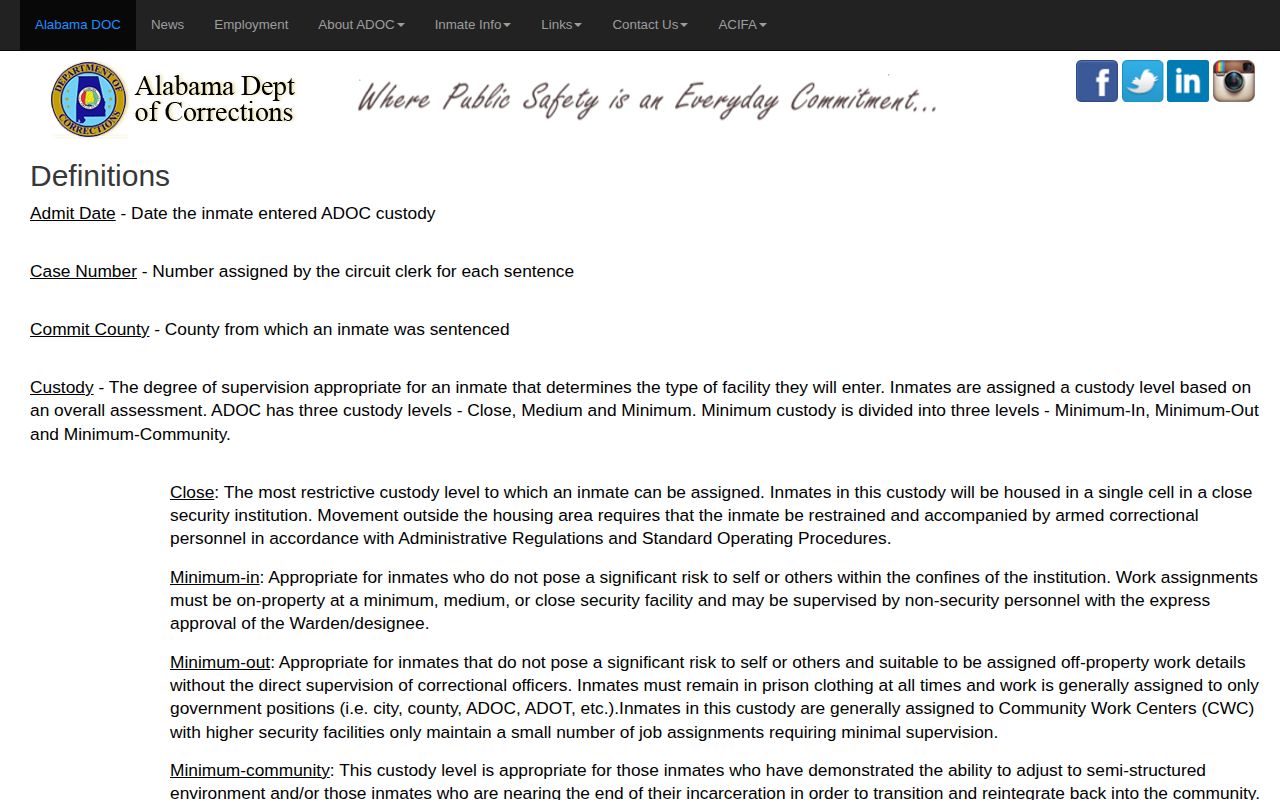
The definitions screenshot supports the distinction between a projected state prison date and a county jail release record. It also connects release timing to jail credit and good-time fields.
| ADOC Field | Why It Matters |
|---|---|
| Minimum Release Date | Earliest scheduled release to probation or end of sentence, subject to change. |
| Jail Credit | County jail time prepared by the circuit clerk of the sentencing county. |
| Good Time Received | Credit that may reduce time served under Alabama correctional incentive time rules. |
| Good Time Revoked | Credit taken away as a disciplinary action, which can move release later. |
| Parole Consideration Date | Tentative parole-board review timing, not the same as physical release. |
| Time Served and Total Term | Sentence-progress fields that help explain how the minimum date is calculated. |
Marshall County Release Credit
Alabama Correctional Incentive Time is governed by Alabama Code Section 14-9-41. The statute applies to people convicted under Alabama law and confined in state prison, at hard labor for the county jail, or in a municipal jail for a definite or indeterminate term, subject to exclusions. It sets earning classes: Class I earns thirty days for each thirty days served, Class II earns fifteen days, Class III earns five days, and Class IV earns none.
The same statute also limits who can receive credit. The research notes exclusions for a Class A felony, a crime causing death by deadly weapon, life or death sentences, sentences over fifteen years, and child sex offenses as defined by Alabama law. Good time can be forfeited for violations, and major violations can permanently affect eligibility. Section 14-9-41 also says the sheriff administers the section for county jail prisoners, which is why Marshall County jail-sentence questions should route to the sheriff or court record.
The Alabama correctional incentive time statute is shown in the manifest screenshot below.
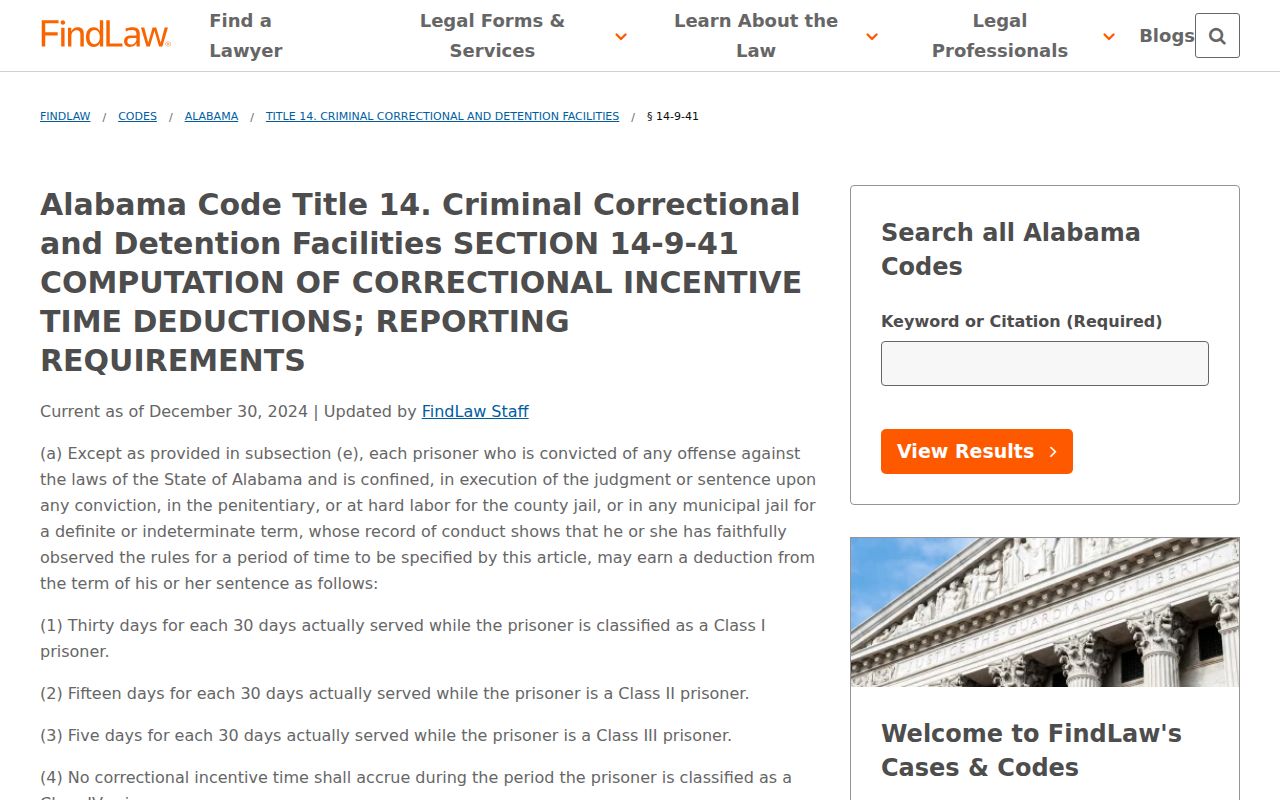
That statute is the source for the good-time note. It should not be treated as a simple calculator, because exclusions, discipline, classification, and local sentence records all matter.
Marshall Jail Date Computation
Angle O from the research is practical: Alabama's official state field is `Minimum Release Date`, but Marshall County jail-credit questions often lead back to the local court. ADOC definitions say jail credit is prepared by the circuit clerk of the sentencing county, and questions about jail credit should go to that clerk. For a sentence out of Marshall County, that means the Circuit Clerk may have the order or credit entry that explains why the ADOC computation looks right or wrong.
The same principle applies inside the county jail. Section 14-9-41 states that the sheriff administers correctional incentive time as it applies to county jail prisoners. That makes the sheriff or Detention Center the practical contact for a county jail sentence release calculation. A person serving a short county term, waiting on bond, or held for a court order should not be pushed into an ADOC release-date search unless the person has actually been committed to state prison custody.
For a Marshall County release date dispute, gather the booking number, case number, sentencing date, jail-credit entry, and any order changing the sentence. Those details let the sheriff, Circuit Clerk, or ADOC identify the record being questioned instead of trying to reconstruct timing from a name search alone.
Why Marshall Release Dates Change
Release dates change because they are built from records that can change. ADOC names discipline and circuit-clerk sentence changes in its definition of minimum release date. Alabama good-time law allows loss of credit. Court records can add a new sentence, correct jail credit, revoke probation, or order release. Supervision can also change the practical date because mandatory supervision and parole processing are not the same as an end-of-sentence discharge.
| Change Factor | Likely Source to Check | Effect on Date |
|---|---|---|
| Good-time loss | ADOC record or jail custodian | Can move a scheduled date later after discipline. |
| Jail credit correction | Marshall County Circuit Clerk | Can move the computation earlier or later depending on credited time. |
| New case or changed sentence | Circuit Clerk and ADOC | Can replace the controlling term or add consecutive time. |
| Detainer or hold | Sheriff, ICE, BOP, court, or receiving agency | May mean the person leaves one custody but enters another. |
| Parole grant or denial | ABPP hearing records | A grant may still require processing; denial leaves the sentence path in place. |
| Mandatory supervision | ADOC, ABPP, and VNS | Can move a person from prison to supervision before final end date. |
Marshall Parole Release Timing
Alabama parole consideration has its own timing. Alabama Code Section 15-22-28 sets parole consideration rules, including the eighty-five percent language for certain listed Class A felonies committed on or after March 21, 2001. That date is for consideration, not an automatic door date. A hearing can lead to grant, denial, continuance, deferral, or later administrative processing.
Mandatory supervision is another separate release path. Alabama Code Section 15-22-26.2 can require certain ADOC inmates to be released to ABPP supervision before the final release date, with windows based on sentence length and exclusions. For Marshall County, supervision may route to the ABPP Guntersville Field Office after a person leaves ADOC custody. That is still a supervised release, not a clean break from all legal control.
The parole-consideration statute screenshot from Justia's Alabama Code page supports the distinction between a hearing schedule and a physical release.
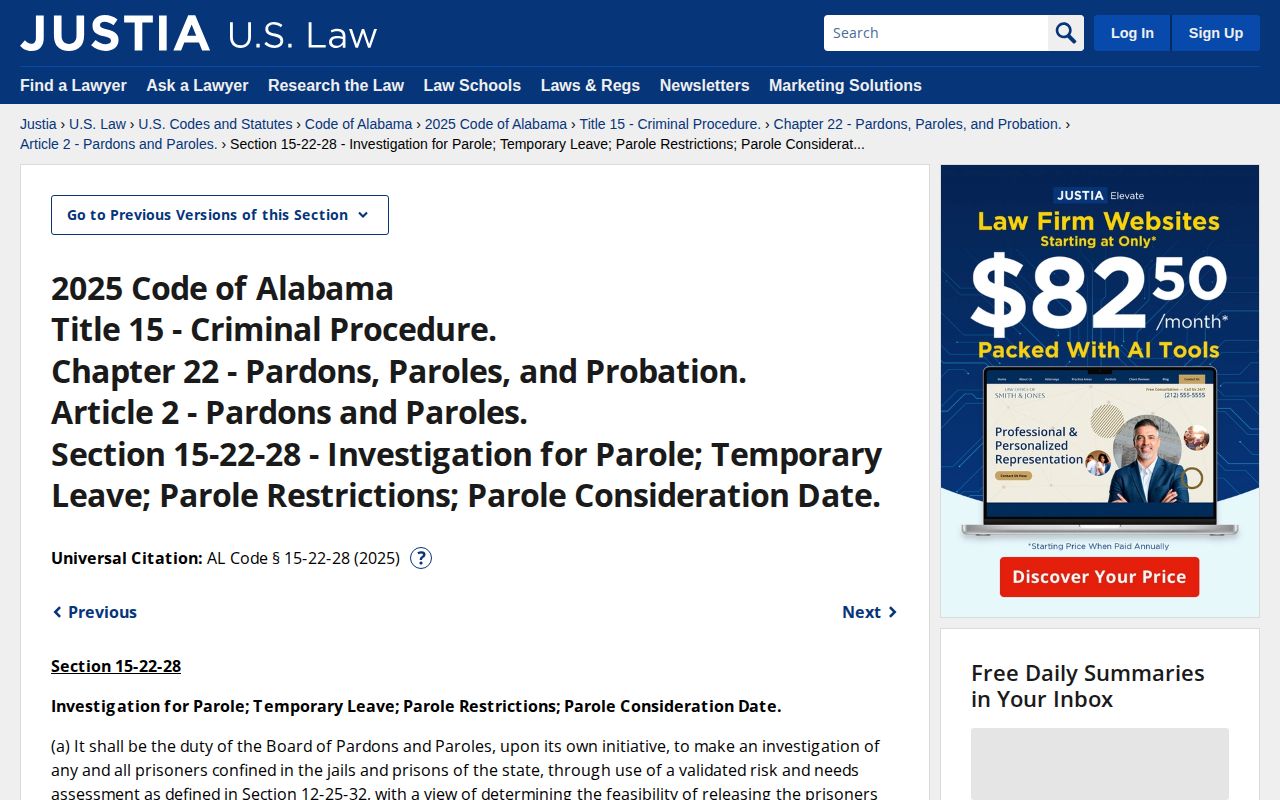
The screenshot is useful because people often confuse parole consideration with the projected release date. They are related, but not interchangeable.
Confirm Marshall County Release Timing
Use the online date as a lead, then confirm it with the record owner. For a Marshall County Jail release, the sheriff's online information is not certified as the official record. The Detention Center or sheriff records custodian can confirm the jail release date, release reason if maintained, and booking number. For a state prison date, ADOC records and definitions control the date fields while the person remains in custody. For a supervision transition, ABPP and VNS may explain why a person leaves prison before the sentence fully ends.
For court-based changes, use the Marshall County Circuit Clerk or AlaCourt Access. The court record can show bond, dismissal, conviction, sentence, split sentence, probation, revocation, time-served credit, commitment to ADOC, or a new order. That record is often the missing link when the jail shows a release date but does not show why release happened.
When two systems disagree, use the record sequence. The court order controls the sentence and jail credit. The sheriff or jail record controls the local booking and actual county release. ADOC controls state prison custody and the minimum release field while the person is current in that system. ABPP controls many supervision questions after parole or mandatory supervision begins. VNS can help eligible users receive notice of certain state events, but it does not replace those source records.
Keep the dates separate in notes or requests. A booking date, sentence date, parole consideration date, minimum release date, mandatory supervision date, and actual release date can all describe different points in the same case.
Note: A person can be released from the Marshall County Jail to another agency, so a jail release date alone does not always mean community release.