
ADOC Release Record Limits
The Alabama Department of Corrections is the state prison custodian, not the operator of the Marshall County Jail. A person may move from a Marshall County court case into ADOC custody after sentencing, but the state system tracks the prison sentence and state release path. ADOC's public inmate search states that its database contains only currently incarcerated inmates and that historical data is not available online. That limitation controls the whole release workflow.
If a person still appears in ADOC search, the public record can help with current custody and release planning. If the person no longer appears, the search result cannot prove why the person left, when the final discharge occurred, or whether supervision followed. Use Alabama VNS, ABPP, the Marshall County court record, or an ADOC public-records request for completed-release confirmation.
Important: No ADOC public result can mean the person has left ADOC custody, was never in ADOC custody, is outside the public search scope, or has a name or identifier issue.
Confirm an ADOC Release
For a Marshall County case that became a state prison sentence, the first question is whether the person is still in ADOC custody. ADOC identifies its search fields as AIS number, first name, and last name. AIS is the state inmate number and is the quickest search route when known. If AIS is used, ADOC says the name fields are ignored. Name searches can be broader but are limited in displayed results.
- Search the ADOC inmate search by AIS number when possible.
- If AIS is unknown, search by first and last name, then compare age, identity details, county, and sentence context before relying on a match.
- If the person appears, read current custody and date fields using ADOC's definitions page.
- If the person does not appear, move to Alabama VNS, ABPP, court records, or ADOC public records instead of treating the absence as a final answer.
- For Marshall County sentencing details, check the Marshall County Circuit Clerk or AlaCourt Access.
The Marshall County released inmates search path is useful when the person may have started in the county jail and later moved into ADOC. The sheriff released roster confirms the county jail booking ended. ADOC confirms current state custody while the person remains in the state prison system.
ADOC Records Contact
ADOC public-records requests are separate from county jail records. The ADOC contact source lists Central Records and the public-records coordinator. ADOC Form 023-A asks for the inmate name, AIS number, date of birth if known, a specific description of the requested public records, preferred format, and certification request. Administrative Regulation 023 explains the processing fee, actual costs, and acceptable submission channels.
Alabama Department of Corrections
301 South Ripley Street
P.O. Box 301501
Montgomery, AL 36130-1501
Main: 334-353-3883
Toll-free: 1-855-WE-R-ADOC (937-2362)
Central Records: 334-353-9738
Public records: public.records@doc.alabama.gov
Request wording should be precise: records confirming release or discharge date, release type if maintained, custody status, and sentence identifier for personal or public-record verification. Include the AIS number if known. If the release is connected to parole or mandatory supervision, the local ABPP field office may be the more practical source for active supervision status.
About Alabama DOC Custody
ADOC custody is the state prison system for sentenced Alabama inmates. It is not the same as being held pretrial in Marshall County Jail, being assigned to Marshall County Community Corrections, or reporting to the Guntersville probation and parole office. The system becomes relevant after a Marshall County sentence sends the person to state custody, or when a state release returns the person to Marshall County under supervision.
The ADOC inmate search screenshot used in the research shows the current-custody limitation that controls ADOC release checks.
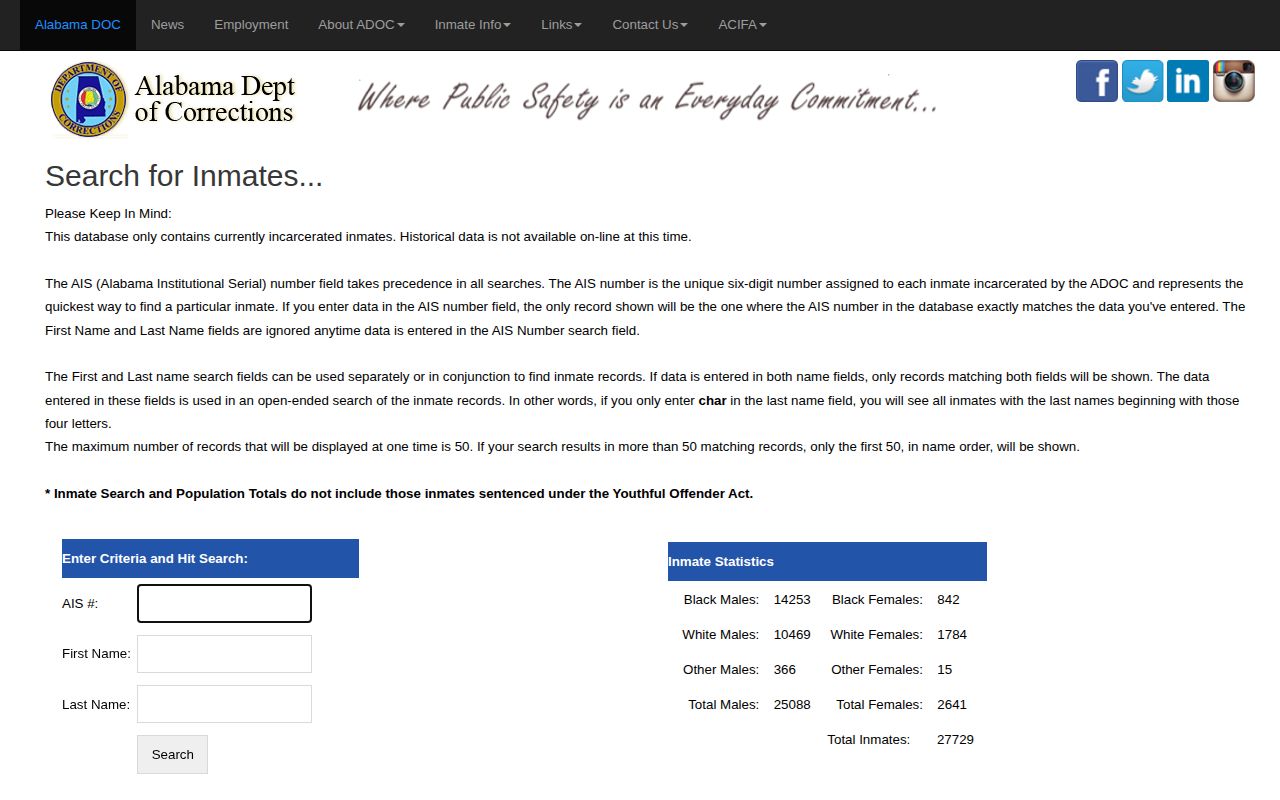
That limitation is why ADOC should be used to read current custody and release-planning fields, then paired with records requests or supervision sources after release.
ADOC Release Date Fields
Alabama's key date label is Minimum Release Date. ADOC defines it as the earliest scheduled date an inmate can be released to probation or end of sentence. It is not a guarantee. ADOC says the date may change if disciplinaries remove good time or if the circuit clerk sends new cases or sentence changes. That is why a projected date should be verified near the expected release window.
| ADOC field | Meaning for release research |
|---|---|
| Minimum Release Date | Earliest scheduled state release to probation or end of sentence, subject to change. |
| Parole Consideration Date | Tentative date set by the Parole Board for consideration, not actual release. |
| Parole Status | Shows parole, delinquent, or revoked status when applicable. |
| Jail Credit | Time credited from county jail, prepared through the sentencing county clerk route. |
| Good Time Received or Revoked | Credits or losses that can shift the minimum release date. |
For Marshall County sentence-credit questions, the court record and Circuit Clerk may explain the county jail credit that ADOC later applies.
VNS and ABPP After ADOC
Alabama VNS is relevant to state prison custody because the VNS site says it is for offenders convicted in Alabama and sentenced to ADOC custody. Its public notice material lists release-related events such as medical release, mandatory-supervision release, custody or status changes, end of sentence, and death. Electronic alerts point the registered user back to the official notice rather than putting full details in a text or email.
ABPP becomes important if the state release leads to parole, mandatory supervision, or probation supervision in Marshall County. The Guntersville Field Office serves Marshall County. ABPP hearing pages can show scheduled hearings and results, while the Public Information Unit handles parole eligibility, hearing dates, hearing results, and questions about inmates granted parole but not yet released. A parole grant is not the same as physical release; processing and holds can still matter.
ADOC Public Records Process
ADOC Form 023-A requires a processing fee for public-records requests, and AR 023 says the fee covers the first hour of labor before work begins. Time-intensive requests can lead to cost estimates and actual-cost billing. A request for an ADOC release or discharge record should be narrow so the public-records coordinator can identify the sentence and custody event.
| Request item | Research detail |
|---|---|
| Form | ADOC Form 023-A, Public Records Request Form |
| Processing fee | $20 non-refundable processing fee |
| Needed identifiers | Name, AIS number, DOB if known, and record description |
| Contact | public.records@doc.alabama.gov or Central Records |
Note: ADOC records are state prison records. A Marshall County Jail release record still belongs with the sheriff.
Marshall County to ADOC
A Marshall County case can touch ADOC after sentencing, but the custody systems remain distinct. The sheriff released roster may show that a county jail booking ended because the person was transferred to state custody. ADOC may then show current custody while the person is in prison. After release, ABPP, VNS, ADOC public records, and the court record become more useful than the current-only inmate search.
For names that do not appear in ADOC, check whether the person was ever sentenced to state prison. Municipal cases, short county sentences, dismissed charges, bonds, and local community-corrections placements may never become an ADOC record. Use the court case to decide whether state prison should be part of the search at all.